
In the Company of Hawks
Special | 10m 36sVideo has Closed Captions
Master Falconer Henry Walters shares the world of falconry and birds of prey in New Hampshire.
After graduating from Harvard, Henry Walters discovered a passion for falconry. Now a Master Falconer in Temple, New Hampshire, he introduces others to the fascinating world of birds of prey.
Problems playing video? | Closed Captioning Feedback
Problems playing video? | Closed Captioning Feedback
Windows to the Wild is a local public television program presented by NHPBS
In the Company of Hawks
Special | 10m 36sVideo has Closed Captions
After graduating from Harvard, Henry Walters discovered a passion for falconry. Now a Master Falconer in Temple, New Hampshire, he introduces others to the fascinating world of birds of prey.
Problems playing video? | Closed Captioning Feedback
Where to Watch Windows to the Wild
Windows to the Wild is available to stream on pbs.org and the PBS app.
Providing Support for PBS.org
Learn Moreabout PBS online sponsorshipMore from This Collection
Individual stories from Windows to the Wild Season 21.
A Year Outside, Painting Together
Video has Closed Captions
Two New Hampshire artists paint the same scenes from two different perspectives. (8m 23s)
Video has Closed Captions
Willem Lange joins a group of retired men walking together in Exeter, New Hampshire (6m 48s)
A Sweet Tradition in the Maine Woods
Video has Closed Captions
A northern Maine family keeps a generations-old maple sugaring tradition alive. (12m 6s)
Video has Closed Captions
Bill Blue and Mike Guillemette help New Hampshire wood ducks by maintaining nesting boxes. (8m 55s)
Video has Closed Captions
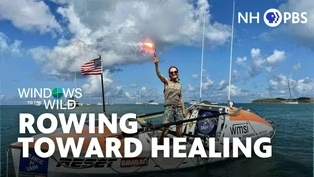
New Hampshire’s Renee Blacken rows 3,200 miles solo across the Atlantic Ocean. (11m 17s)
Video has Closed Captions
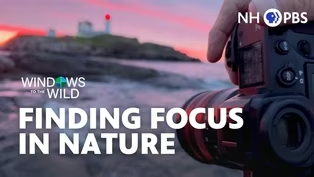
New Hampshire radio host Greg Kretschmar finds healing through nature photography. (8m 45s)
Providing Support for PBS.org
Learn Moreabout PBS online sponsorshipIn Temple, New Hampshire, just beyond the Connolly Brothers dairy farm, you'll find an old red barn.
The Grouse Woods at Red Gate Farm is home to an abundance of wildlife.
The landscape has been tended to by the Connolly family for decades.
It's where we meet Henry Walters.
The birds are here in our aviaries, which are.
Modified from old.
This was the old dairy barn and was then turned into Basset Hound kennels.
And then we've we've turned them into Hawk aviaries.
Are they happy to see you?
They are happy to see me.
Oftentimes they're the falconers main job is really figuring out what time of day they're they're eager to fly.
Henry is a master falconer.
His road, to New Hampshire began at Harvard, where he studied Latin and ancient Greek.
After graduating, a traveling fellowship took him to Ireland.
How did you gravitate from there to here?
I went to Ireland to do my falconry apprenticeship, it's still passed down by the apprentice system and lived there for a couple of years, learning from a couple of great falconers.
And at that point working with birds was in my blood.
This is Mahood?
Mahood, an Irish name.
How do you spell it?
Mahood.
Monadnock Falconry is Henry's business and passion.
He leads visitors on tours where they come face to face with raptors.
Hey, he heard that.
You like that, But this is the one bird of prey out of all those that we work with.
And the one species that's willing to see you really as part of his hunting group right from the beginning.
With others, it might be 2 or 3 weeks of working with him each day before he's willing to take your glove and trust it as a as a perch and trust you as a, as a partner.
Monadnock falconry began out of a love for birds.
Henry teamed up with Martin Conley.
Martin grew up in the Bronx.
It's where he nourished an injured kestrel.
Back to health right in his bedroom.
That boyhood experience turned into a lifetime of falconry and raptor rehabilitation.
Birds will come into us, given by good Samaritans by New Hampshire fish and game.
If if we can't help them directly, we'll pass them on to other rehabilitators in the state.
Martin was sick the day we filled and couldn't join us.
Several weeks later, he died.
Should we head up this way?
Marshall Hudson introduced us to Henry.
He's a retired land surveyor who, by the nature of his work, comes across interesting people and places around New Hampshire.
Just tuck in a little piece of pheasant here.
Yes, that will do it.
And if you give him a peek at what you've got there, Now go ahead and open your fingers.
He'll take it right out.
Yeah He writes about them for New Hampshire magazine.
Henry is one of those stories.
He's not very heavy.
Lighter than you would think.
And looking him eyeball to eyeball is kind of this eyeball to eyeball feeling when you're checking each other out.
It's kind of a neat feeling.
Mahood is a Harris's hawk.
The species is non-migratory.
It's found from the southwestern United States to Argentina.
Mahood arrived here from a bird of prey center in upstate New York, where his injured mother nested and raised chicks.
His mother had been injured in the wild and had chicks in in Edinburgh prey center in captivity.
And so he physically has never been injured.
But he doesn't have the way he's orphaned from that social group that that he would need to survive in the wild.
And so our hope in working with three Harris Hawks here at the moment is that they will form sort of a social and the same sort of social group that they do in the wild.
Besides being a master falconer, Henry worked as a biologist for New Hampshire Audubon.
He co-founded the New Hampshire Young Birders Club.
Take a walk with him and you'll learn something interesting about these birds.
And his eyesight is so good.
I mean, he's seeing 8 or 9 times more detail than than we are.
So I usually take my cue from him if he's seen something move here.
If I follow his gaze, usually I stumble across whatever he is looking for.
Oftentimes, when we see a bird of pray in the wild, it's a 3 or 4 second thing.
It happened so fast.
We don't get to appreciate that there's a whole life happening there.
And oftentimes, working with birds in a falconry setting is the way of is the way of appreciating that.
Why is it important for you to connect people with that.
I think because it was my portal into a delight in the natural world, into a, into a further knowledge about the natural world.
And, I have children of my own who I, I want to connect to the natural world.
This is I think this is a way of feeling a connection that doesn't have to be taught, but can simply be felt.
He's eating here, and when he's got a larger piece of food, he'll really drop those wings and mantle over it in a way that clearly says, hey, this is this is mine, and keep your distance.
As our videographer, Adam Goodin found out something stirring there or stirring something up.
Hawks look for any vantage point to hunt from.
His best chance to catch it will be That's a spot.
Sorry about that.
Well, Adam, how are you feeling?
Pretty cool.
You got a perfect.
A perfect launching point from there.
Marshall, if you give him a glove, he may hop over to you.
Yeah, that may not be the spot, but.
As soon as we get into this brushy stuff here, he's all of a sudden doing sort of a double thing all the time, keeping one eye on us where we're going and also looking out for himself, looking for prey.
And if we can help in that, great.
And if we.
We can't, he's going to do it himself.
But he's not altering much of his wild, his wild habits to to suit us.
And certainly if he goes and catches prey, he's not going to bring it back to us.
He's always in it for himself.
May I give you a bit of food here see if he'll come down to you from there.
That'd be great.
Here he comes.
He saw something.
That's something better.
He's got something better.
A ring necked pheasant.
You saw him flush it.
Hey hey hey hey hey.
Oh!
Well, he got a pretty late jump.
It's gonna be a hard a hard bird to chase down, but he's not daunted.
Oh, what might he catch?
Everything from chipmunks to to rabbits and pheasants so some pretty large game.
He's caught ducks off this pond.
So he's pretty quick.
He's built like a sprinter, as opposed to a falcon getting way sky high and patrolling a big area at once.
Nice.
Now, tell me you didn't feel a little thrill of emotion when that happened.
If you turn your back on him, he likes coming to the back of the glove a little.
It's a little easier for him to land.
Henry's tours are hands on.
Yup.
He dropped it there.
And Mahood is happy to participate.
This species actually spends quite a bit of time on the ground, which is quite comical.
They're they're quite long legged.
What Henry and Martin started here at Monadnock Falconry, is more than a bird in hand.
It's a bond with the natural world.
And the birds he works with.
Yeah, there's.
There's so much love going that way.
And a desire for there to be some emotional connection.
There certainly is on my end.
It's very unclear to me, even after 18 years of working with Birds of Prey, whether.
What emotional bond is there on the other side to be let into that world and to be invisible, except as a hunting partner is a thrill.
 New Season
- Drama

Hugh Bonneville stars in a crime drama inspired by one of the largest robberies in British history.
 New Episode
- News and Public Affairs

Top journalists deliver compelling original analysis of the hour's headlines.
 New Season
 New Episode



 New Episode
Support for PBS provided by:
Windows to the Wild is a local public television program presented by NHPBS